What to Say to a Grieving Person (and What You Should Never Say)
Why good intentions sometimes hurt
When someone we know loses their spouse, most of us genuinely want to help. We show up. We bring food. We offer words. But here is a hard truth many of us never learn: some of the most common things we say to a grieving widow, however kind our intentions, can quietly deepen her pain.
At Gritty Widows Foundation, we work closely with widowed women across Nigeria, and we hear the same thing again and again: “People meant well. But their words made me feel more alone.”
If you have ever stood in front of a grieving person and not known what to say, this guide is for you.
Why good intentions sometimes hurt
Grief makes people uncomfortable. So we reach for phrases that tidy it up, that make the moment feel less heavy for us. But grief isn’t a problem to be solved or hurried along. It’s a weight to be carried slowly, one day at a time. When we try to fix it, we usually end up dismissing it.
Still with us?
Get the next story like this one straight to your inbox.
Take a widow we’ll call Susan. In the weeks after her husband died, visitors came to her home almost every day: family, neighbours, church members, well-wishers, all with sympathetic faces and good intentions. Yet the more they spoke, the more alone she felt. It wasn’t their presence that wounded her. It was their words.
So the goal isn’t to find perfect words. It’s to avoid the wrong ones, and to offer real presence in their place.
Five things to avoid saying
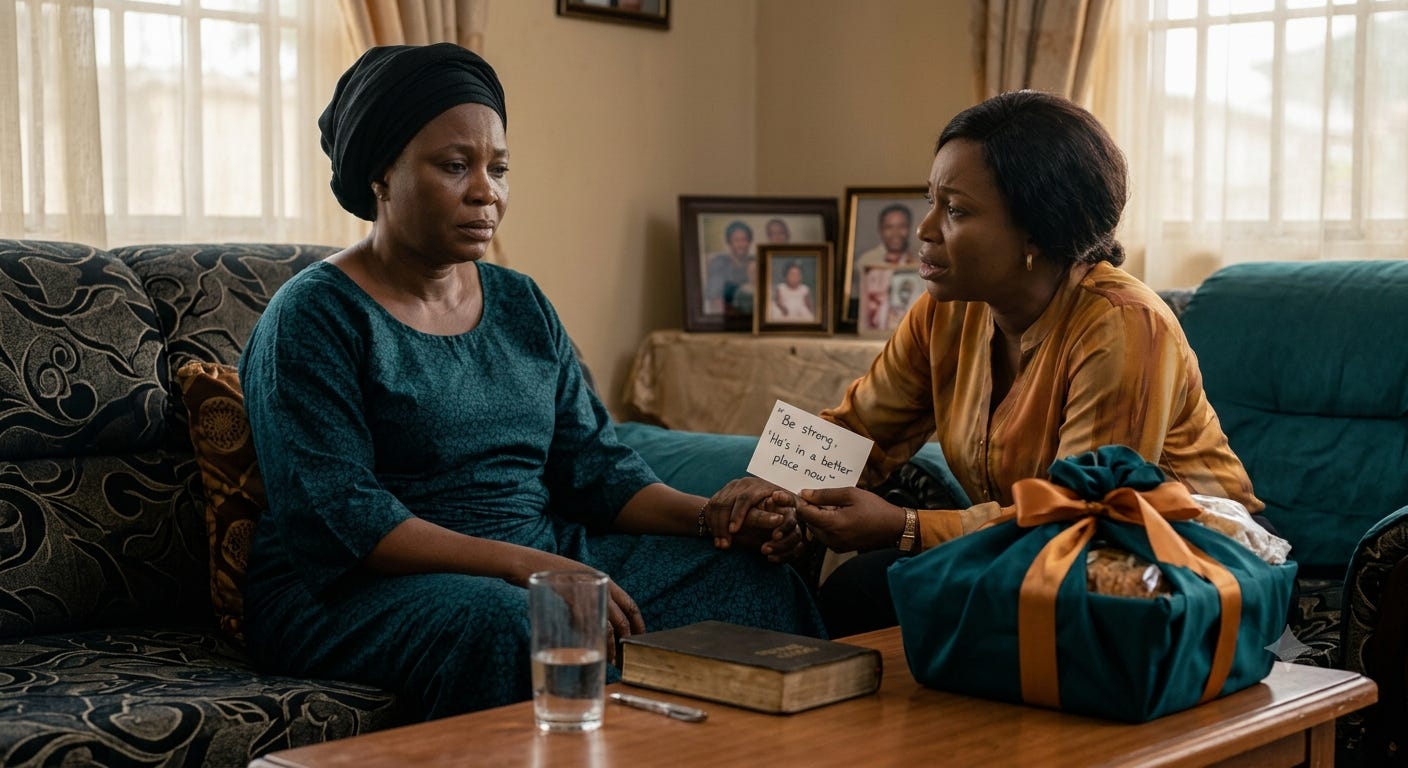
“At least he’s in a better place”: She knows. But that better place is one she can’t reach, and pointing to it only underlines the distance between them. It puts the comfort of the afterlife instead of her reality right now. She doesn’t need reminding where he is. She needs someone to notice where she is.
“You have to be strong”: This might be the heaviest phrase of all. It tells a grieving woman she isn’t allowed to fall apart, that her pain is a burden she has to hide for everyone else’s sake. No one should have to perform strength while their world is collapsing. Often the kindest thing you can offer is permission not to be strong.
“Everything happens for a reason”: She isn’t looking for reasons. She’s mourning a person. Offering philosophy in place of compassion can land like being told her pain is part of a plan she never agreed to. Some pains don’t need an explanation, only company.
“You’re still young. You’ll find someone else”: A spouse isn’t replaceable. Years of shared memory and love and ordinary life can’t be swapped for a new person, and however lightly it’s meant, this one can feel like a dismissal of everything she’s lost.
“It’s been a few weeks now. You should start moving on”: Grief has no expiry date. Putting a clock on someone’s mourning tells them their healing is inconvenient. Twenty-one days, three months, a year, everyone grieves on their own timeline, and that timeline belongs to no one but them.
What to say instead
The most comforting people are rarely the most eloquent. They’re the ones who show up honestly and stay.
Some time after the hardest week, a neighbour came to Susan’s door. She didn’t say “everything happens for a reason.” She didn’t say “be strong.” She simply said, “I’m so sorry. This must be incredibly difficult. You don’t have to do this alone.” Then she mentioned she’d brought groceries for the week, and that she’d pick the children up from school on Thursday so Susan could rest.
For the first time in weeks, Susan felt her shoulders drop, not because her grief had ended, but because someone had finally understood.
That’s the shape of it: simple acknowledgement, paired with concrete help. In practice, that means a few things.
Offer specific help rather than the vague “let me know if you need anything,” which quietly hands the work back to her. Say “I’ll bring dinner on Tuesday” or “I’ll take the children on Saturday.” Sit with her pain without rushing to fill the silence. Let her talk about her late husband, and use his name when you do, because that’s a gift, not a risk. And keep showing up after the funeral crowd has thinned, because that’s when the loneliness is loudest.
Why this matters
Widowhood isn’t only the loss of a spouse. It’s the reshaping of an entire life, often overnight, and frequently while raising grieving children alone. The way a community responds in those first raw weeks can either deepen a widow’s isolation or begin her healing.
At Gritty Widows Foundation, this is the heart of our work. We walk alongside widowed families with practical support, empowerment programmes, and a community that doesn’t disappear once the condolences end. Because healing begins the moment a widow is reminded she doesn’t have to carry the weight of grief alone.
IIf you’d like to be that steady presence for a widow in our community, through giving, volunteering, or partnership, we’d love to hear from you.
With you in it,
Grace
Gritty Widows Foundation
Ready to put this into practice? Join us as a volunteer.

Education, Community and Mentorship: How to Truly Support Low-Income Widowed Families
Why keeping a child in school takes more than school fees, and how a village can change everything
Read next →